Supply Chain Management Is a Governance Problem
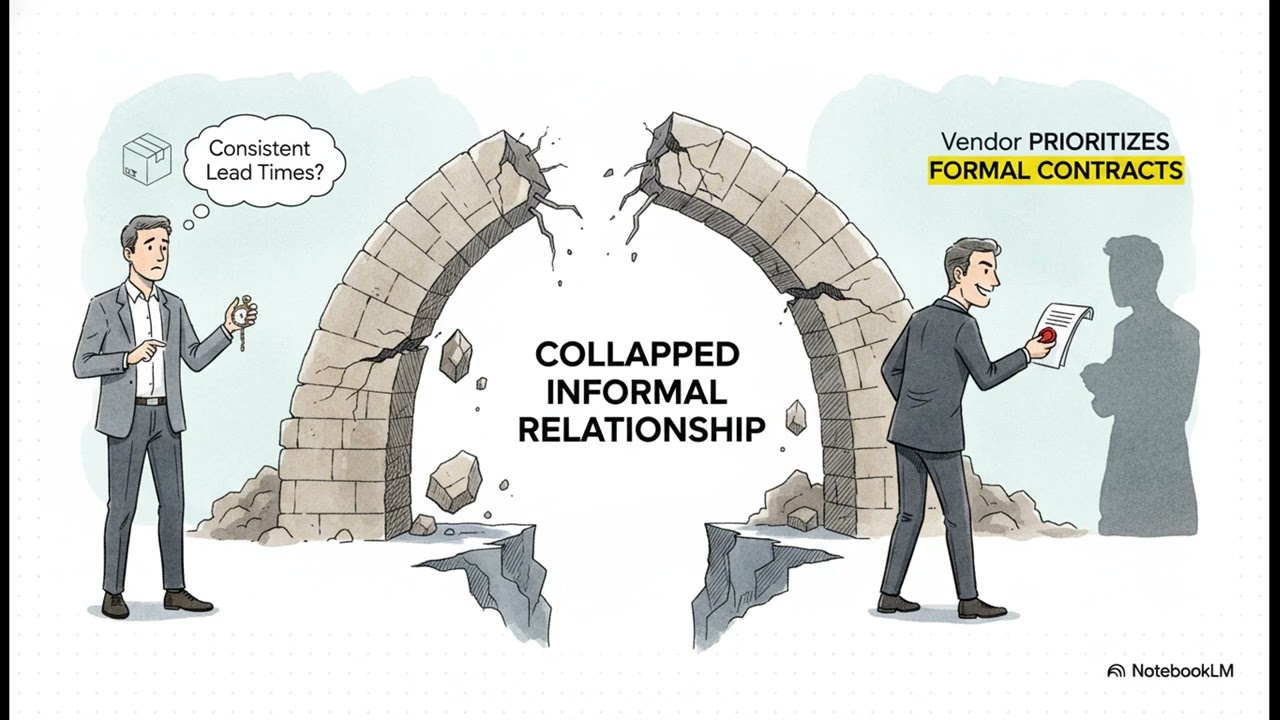
Supply chain failures present as supplier failures and are usually something else. Most of the variability a mid-market company experiences upstream was manufactured by its own ordering behavior. Fixing that requires changing internal decisions rather than changing vendors.
Variability grows as it travels upstream
Customer demand for a given item is generally steadier than the orders a company places for it. Each step back through the chain amplifies the swing, so a modest change at the point of sale arrives at the supplier as a severe one.
That amplification is well documented and consistently underestimated. The supplier experiences erratic demand, protects itself with longer quoted lead times and higher minimums, and the buyer experiences those protections as poor service.
Both parties then describe the other as unreliable. Neither description is accurate, because the pattern is generated by the structure connecting them rather than by either organization's competence.
The causes of amplification are internal decisions
Four behaviors produce most of the swing, and each is a choice somebody made for a defensible local reason.
Order batching comes first. Placing a large order every several weeks instead of a smaller order every week converts steady consumption into a spiky signal, and the spikes are what the supplier plans against.
Forecasting from orders rather than from consumption comes second. A supplier reading its customer's order pattern is reading an already distorted signal and amplifying the distortion again for its own suppliers.
Promotional buying is third, since a discount pulls future demand forward and leaves a trough behind it. Shortage gaming is fourth, where buyers inflate orders during scarcity to secure allocation and cancel once supply recovers.
Reliability matters more than speed
Buyers negotiate hard on quoted lead time and rarely on the variance around it. That priority is inverted for almost every operation.
A supplier who reliably delivers in six weeks can be planned around with a modest buffer. A supplier who averages three weeks but ranges from one to seven cannot, and the buffer required to absorb that range costs more than the four weeks saved.
Measure the spread rather than the average before renegotiating anything. Consistency in delivery is the property that reduces the working capital an operation must hold, and it is almost never what the negotiation is about.
Suppliers are not one category and should not share one playbook
Applying the same commercial approach to every vendor wastes attention on items that do not matter and underserves the few that do. Segmentation solves this cheaply.
The Kraljic model sorts purchases on two axes, being financial impact and supply risk. Items low on both are administrative and should be automated out of anyone's calendar. Items high on financial impact and low on risk are where competitive tendering earns its keep.
The quadrant that matters is high risk with meaningful impact. Those relationships need collaborative planning, shared forecasts, and named contacts on both sides, because the alternative to partnership there is exposure the purchase price never reflected.
Supplier power is a structural position, not a negotiating mood
Porter described supplier power as a force shaped by structure rather than by conduct. Concentration in the supply base, absence of substitutes, and switching costs each raise it independently of how either party behaves.
Recognizing the position changes what a negotiation can achieve. Where structural power sits with the supplier, pressing for price produces short term movement and a degraded relationship, and it does nothing about the underlying condition.
The durable responses are structural in turn. Qualify an alternative source, redesign the specification toward a more available input, or accept the position deliberately and manage it. Each is slower than a negotiation and each actually changes something.
Total landed cost is the number the purchase order does not show
Purchase price is the visible figure and rarely the relevant one. Freight, duty, inspection, expediting, rework caused by variable quality, and the working capital tied up by long or unreliable lead times all attach to the same decision.
A cheaper unit price frequently arrives with a longer lead time and a wider delivery spread. The buyer books a saving and the operation absorbs the difference somewhere it will never be attributed back.
Reconstruct the full cost for the handful of items that matter most. The exercise takes days rather than weeks and regularly reverses a sourcing decision that looked settled.
The decoupling point is a governance decision
Every operation holds inventory somewhere between raw input and finished output. Where it holds that stock determines both responsiveness and capital consumption, and the position is usually inherited rather than chosen.
Holding generic material and configuring late gives flexibility across many end items with less total stock. Holding finished goods gives immediate availability at the cost of guessing the mix in advance.
Naming the decoupling point explicitly turns an accident into a decision. It also makes the tradeoff legible to finance and operations at the same time, which is generally the first time both have discussed it in the same terms.
The service measure most companies report is the wrong one
Line fill rate counts how many order lines shipped complete. On time in full counts how many complete orders arrived when promised. Those two figures can differ dramatically for the same operation.
Customers experience the second and internal reporting usually tracks the first, which is why service can appear strong while accounts describe the opposite. The measurement gap sustains the disagreement indefinitely.
Report the number the customer feels. Where that number is uncomfortable, the discomfort is information rather than an argument for a different metric.
Visibility ends at the first tier and the exposure does not
Most companies know their direct suppliers and almost nothing about who supplies them. A disruption two tiers back arrives with no warning and no obvious cause.
Mapping the second tier for critical items is a finite piece of work. Ask the direct supplier where the input originates and whether an alternative exists, then record the answers where somebody will look at them again.
Discipline here is simply doing it before it matters. The mapping is inexpensive when nothing is wrong and impossible to complete during a shortage.
Repair the signal before replacing the supplier
The cheapest available improvement is usually to stop distorting the demand signal, and it requires no supplier conversation at all. Three changes do most of the work.
Order on a shorter and more regular cadence, even where the quantity per order falls. Smaller regular orders cost slightly more in administration and remove a large share of the amplification the supplier is planning against.
Share actual consumption rather than only orders. A supplier who can see what is being used, rather than inferring it from a batched purchase pattern, plans against reality. The padding for a variability that was never real then comes out of the quoted lead time.
Then build the ordering rules into the systems rather than leaving them to judgement. Rules that live in someone's head get abandoned during the exact weeks that generate the worst distortion. Those are the weeks when a buyer is busy and reaches for one large convenient order.
Naming the models that make this legible
Two frameworks and one accounting habit carry most of the analysis, and each answers a different question.
The segmentation model answers where to spend attention. The supplier power analysis answers what a negotiation can realistically achieve. Total landed cost answers whether a sourcing decision was actually a saving.
Sales and operations planning is the methodology that connects them to the rest of the business. Its value is a single monthly forum where demand, supply, and finance agree one set of numbers, which is a modest ambition that most mid-market companies have not yet met.
Conditional rules for supplier decisions
Where a supplier is described as unreliable, examine the ordering pattern sent to them before changing vendors. Switching reproduces the amplification against a new party.
Where an item is high risk and low spend, treat it as high priority regardless of its value. Spend is a poor proxy for exposure, and the cheapest input can stop the line.
Where a price concession has been won without any structural change, expect it to reverse. Negotiated movement against a strong structural position is a loan rather than a saving.
Where lead time variance exceeds the buffer currently held, raise the buffer or fix the variance. Continuing with neither means the operation is absorbing the difference through expediting and overtime.
What the chosen position requires
Supply chain design follows from what the business competes on rather than from a generic efficiency target. An operation selling on availability needs stock and dual sources. One selling on price needs the opposite and should say so plainly.
Strategic fit resolves arguments that otherwise run indefinitely between functions. The question is not whether inventory is good or bad, but whether this business has promised something that inventory is required to deliver.
Operational excellence in sourcing is the alignment between that promise and the structure built to keep it. Stakeholder value erodes quietly wherever the two have drifted apart and nobody has reconciled them.
Governance protects the people absorbing the disruption
The argument for building this is not procurement tidiness. Where the structure generates instability, a small group of people spend their weeks expediting, apologizing, and rebuilding schedules that were never achievable.
That work is invisible in any report and expensive in human capital, because it consists almost entirely of absorbing consequences somebody else's decision created. Servant leadership expressed operationally means removing the generator rather than praising the people coping with it.
Trust between functions recovers once the ordering behavior stabilizes. Coherence between planning, purchasing, and operations is what makes that stability possible, and it is a design output rather than a matter of goodwill.
Watch the full explainer
Related
Further material on management consulting and operational structure from World Consulting Group: [www.worldconsultinggroup.com](https://www.worldconsultinggroup.com)