-
You set annual goals in January. By March nobody remembers them.
You set annual goals in January. By March nobody remembers them.
Kamyar Shah, Fractional Executive, World Consulting Group.
-
You set the goals. Nobody’s measuring if they’re hit.
You set the goals. Nobody’s measuring if they’re hit.
Kamyar Shah, Fractional Executive, World Consulting Group.
-
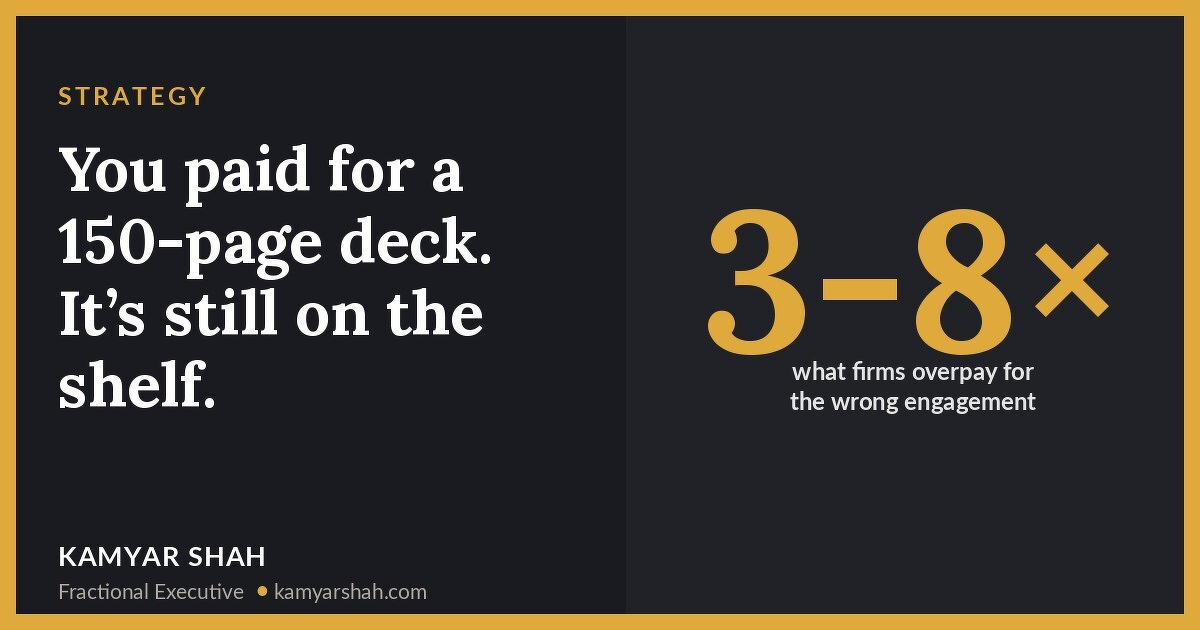
You paid for a 150-page deck. It’s still on the shelf.
You paid for a 150-page deck. It’s still on the shelf.
Kamyar Shah, Fractional Executive, World Consulting Group.
-
Consultants aren’t too expensive. You bought the wrong engagement.
Consultants aren’t too expensive. You bought the wrong engagement.
Kamyar Shah, Fractional Executive, World Consulting Group.
-
Your systems aren’t breaking. You’re hiring the wrong title.
Your systems aren’t breaking. You’re hiring the wrong title.
Kamyar Shah, Fractional Executive, World Consulting Group.
-
You paid six figures for a deck nobody can run.
You paid six figures for a deck nobody can run.
Kamyar Shah, Fractional Executive, World Consulting Group.
-
What built you at $2M will break you at $10M.
What built you at $2M will break you at $10M.
Kamyar Shah, Fractional Executive, World Consulting Group.
-
You’re watching rivals. The forces squeezing your margins sit elsewhere.
You’re watching rivals. The forces squeezing your margins sit elsewhere.
Kamyar Shah, Fractional Executive, World Consulting Group.
-
Your edge isn’t rare. Competitors copied it already.
Your edge isn’t rare. Competitors copied it already.
Kamyar Shah, Fractional Executive, World Consulting Group.
-
You cut costs everywhere, yet margins still won’t move.
You cut costs everywhere, yet margins still won’t move.
Kamyar Shah, World Consulting Group.
-
The analysis was fine. The change management killed it.
The analysis was fine. The change management killed it.
Kamyar Shah, Fractional Executive, World Consulting Group.
-
You keep fixing departments. The broken model pulls them back.
You keep fixing departments. The broken model pulls them back.
Kamyar Shah, World Consulting Group.
-
Generic strategy frameworks were built for enterprises. They fail SMBs by design.
Generic strategy frameworks were built for enterprises. They fail SMBs by design.
The BCG matrix, the balanced scorecard, the OKR cascade. These tools were built for organizations with dedicated strategy functions and full-time analysts. Applied to a $5M to $25M company with a four-person leadership team, they produce overhead without outcomes.
Here is what actually works instead.
Kamyar Shah, Fractional Strategy Consultant, World Consulting Group.
-
The strategy is already broken. The revenue just has not confirmed it yet.

The strategy is already broken. The revenue just has not confirmed it yet.
There is a phase in every strategy breakdown where the numbers are still acceptable but the underlying conditions have already deteriorated. Strategic drift, accountability gaps, and incentive misalignment compound below the surface while the team stays busy.
Here is how to read those signals before the revenue confirms them.
Kamyar Shah, Fractional Strategy Consultant, World Consulting Group.
-
Alignment is not the solution to your strategy problem. It is a sign the problem was already solved.
Alignment is not the solution to your strategy problem. It is a sign the problem was already solved.
When a leadership team achieves alignment, it means a decision was finally made. Alignment itself produced nothing. Companies that treat alignment as the goal rather than the outcome of good decision-making will spend planning cycles in consensus-building rather than execution.
Kamyar Shah, Fractional Strategy Consultant, World Consulting Group.
-
If two people think they own the same decision, neither of them does
If two people think they own the same decision, neither of them does
Ambiguous decision rights produce bottlenecks, duplicated effort, and escalation loops that slow execution to a standstill. Clarifying who decides what, and at what level, is one of the highest-leverage structural interventions available to a growing company.
Kamyar Shah, Fractional Strategy Consultant, World Consulting Group.
-
A decision that gets relitigated is not a decision. It is a recurring meeting.
A decision that gets relitigated is not a decision. It is a recurring meeting.
Decision durability is not about finality for its own sake. It is about building the conditions under which a decision can hold under pressure, changing circumstances, and internal resistance. Most mid-market companies have zero architecture for this.
Kamyar Shah, Fractional Strategy Consultant, World Consulting Group.
-
Your strategy is not failing because of disagreement. It is failing because no one knows who gets the final call.
Your strategy is not failing because of disagreement. It is failing because no one knows who gets the final call.
Leadership teams can disagree and still execute well if decision authority is explicit. Without it, every strategic decision becomes a negotiation that never fully resolves. The ambiguity kills momentum faster than the disagreement ever could.
Kamyar Shah, Fractional Strategy Consultant, World Consulting Group.
-
Shared ownership of a strategic initiative means no one owns it

Shared ownership of a strategic initiative means no one owns it
When accountability is distributed across a leadership team without a single named owner, every difficult decision gets escalated, delayed, or avoided. Shared ownership is not collaboration. It is a structural condition for non-execution.
Kamyar Shah, Fractional Strategy Consultant, World Consulting Group.
-
Your team is not resisting the strategy. They are responding rationally to the wrong incentive structure.
Your team is not resisting the strategy. They are responding rationally to the wrong incentive structure.
When compensation rewards behaviors that conflict with strategic priorities, employees optimize for the reward. Every time. This is not a culture problem. It is a system design problem, and it is the most common reason new strategies fail to gain traction after announcement.
Kamyar Shah, Fractional Strategy Consultant, World Consulting Group.
-
New strategy. Old operating system. That is why the plan died.
New strategy. Old operating system. That is why the plan died.
You can have the right direction and still fail execution if the processes, incentives, and workflows were built for a different strategy. Strategic transformation without operating system redesign is one of the most predictable failure patterns in mid-market companies.
Kamyar Shah, Fractional Strategy Consultant, World Consulting Group.
-
At some point, delayed decisions stop being prudent and start being a breach
At some point, delayed decisions stop being prudent and start being a breach
There is a threshold at which leadership delay in acting on a known problem crosses from caution into negligence. For executives with fiduciary responsibility, that threshold is lower than most think.
This defines when delay becomes a violation and what the exposure looks like.
Kamyar Shah, Fractional Strategy Consultant, World Consulting Group.
-
Busy is not a strategy. It is a symptom of one that is missing.
Busy is not a strategy. It is a symptom of one that is missing.
When a leadership team cannot explain a missed commitment beyond being overwhelmed, the real diagnosis is a prioritization failure, not a capacity problem. Busyness is what happens when strategy does not exist to tell you what not to do.
Kamyar Shah, Fractional Strategy Consultant, World Consulting Group.
-
Operational capacity is not just an operations issue. It is a fiduciary one.
Operational capacity is not just an operations issue. It is a fiduciary one.
Leaders who allow systems, staffing, or infrastructure to degrade below the threshold required to meet obligations are not just underperforming. They are in breach of a duty. This reframe changes how boards and CEOs should think about resource allocation decisions.
Kamyar Shah, Fractional Strategy Consultant, World Consulting Group.
-
The gap between when AI gives you an answer and when you act on it is costing you competitive ground
The gap between when AI gives you an answer and when you act on it is costing you competitive ground
Advisory latency is the delay between insight generation and organizational action. In an AI-accelerated environment, this lag has become the primary source of competitive disadvantage for mid-market companies that have the tools but not the operating rhythm to deploy them.
Kamyar Shah, Fractional Strategy Consultant, World Consulting Group.
subscribe via RSS